
Sunday, October 7, 2012

Sunday, June 24, 2012
Leading Edge D-Structure: 2.3 kg

Thursday, June 21, 2012
Detailed Wing Structure
I'm working on the detailed wing structural model, starting with the front D-Section.
Ribs - 20 mm extruded polystyrene 28 kg/m3
Spar is 100 x 10 x 3000 mm dimension
Spar Caps - unidirectional carbon
Spar Web - Vertical Grain Light Balsa, 120 kg/m3
Spar Faces - 45 deg. fiberglass 0.2-0.5 mm thick to be determined
D-Section shell: 0.8 mm aicraft plywood
Strut attachment is not yet in place in these pictures (it will be at 50% span)


Ribs - 20 mm extruded polystyrene 28 kg/m3
Spar is 100 x 10 x 3000 mm dimension
Spar Caps - unidirectional carbon
Spar Web - Vertical Grain Light Balsa, 120 kg/m3
Spar Faces - 45 deg. fiberglass 0.2-0.5 mm thick to be determined
D-Section shell: 0.8 mm aicraft plywood
Strut attachment is not yet in place in these pictures (it will be at 50% span)


Friday, May 11, 2012
Wing Analysis

Red - 60 mm2
Orange - 40mm2
Green - 30mm2
Light Blue - 15mm2
Dark Blue - 6mm2
We need to use for each spar cap, the larger of the two sections for the 6G positive or 3G negative case. This means, basically, tapering from 60mm2 at the wing root (required for the 3G neg case), down to about 35 mm2 at the strut attachments (required for the 6G pos case), and then tapering down to zero at the wingtip.
Tuesday, May 8, 2012

Principal flight loads are handled by unidirectional carbon fiber in the spar caps.
The color corresponds to the mm2 of unidirectional carbon that will be necessary (spar cap section):
Red - 40 mm2
Orange - 30 mm2
Yellow - 25 mm2
Green - 15 mm2
Light Blue - 10 mm2
Dark Blue - less than 5 mm2
The behaviour in negative G will be different because the struts do not have any compression capacity. Negative G is handled by the wing root and it will increase the forces in the center section between the struts.
Saturday, November 26, 2011
Definitive Design Choice
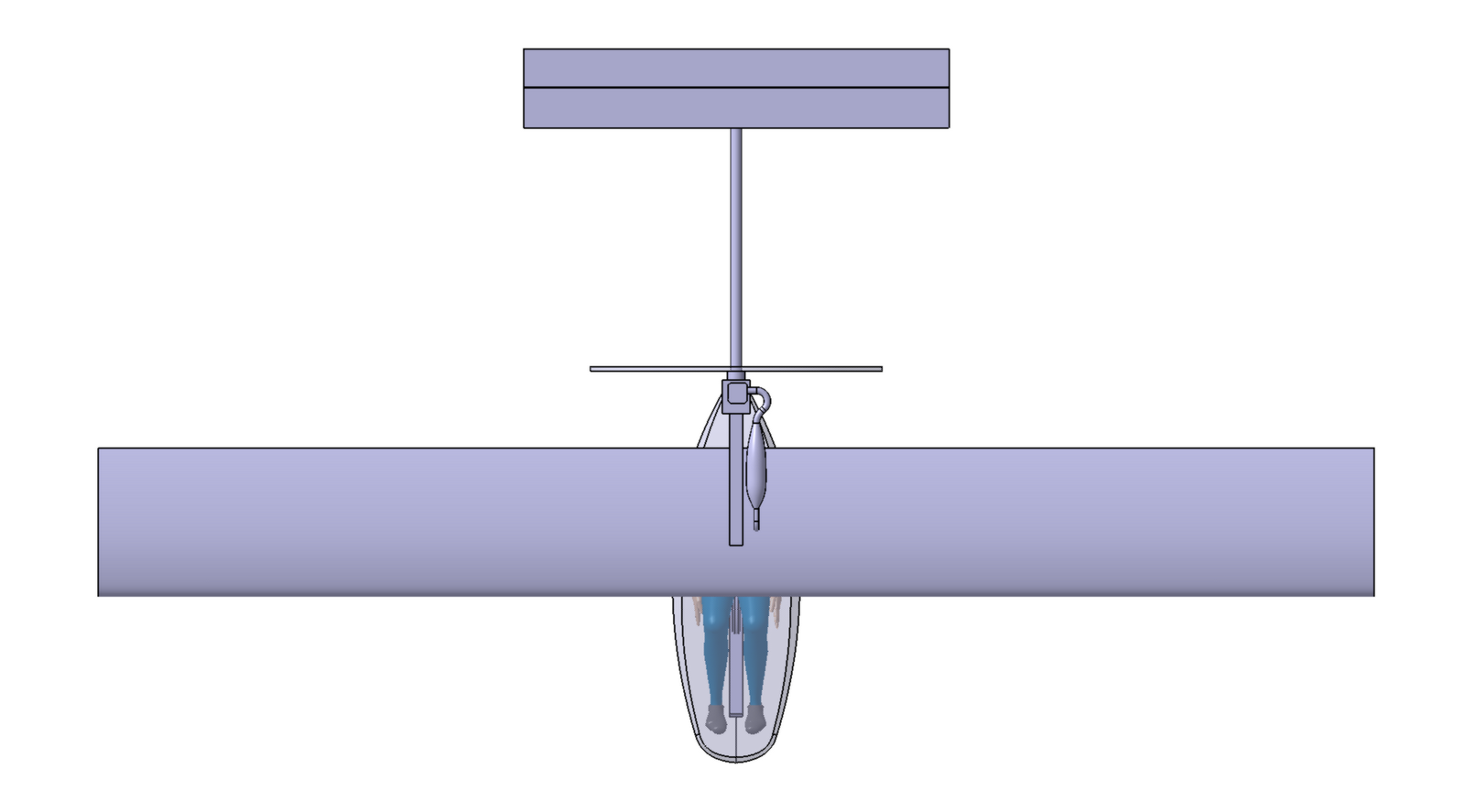
Jean-Pierre showed the previous iterations to a group of pilot friends and they felt that the prop rotating around the boom was a good idea and that we should go back to it. So our latest design combines the high wing with the boom going through the prop hub. Spec is still 31 kilos dry.



Tuesday, November 1, 2011
 |
Another version. The fairing construction is not fully decided. The wheel is a standard 305-mm bicycle rim with 375 mm outer diameter. It's very sturdy and if it breaks you can rebuild it with more spokes or thicker spokes. Conventional controls with a side mounted stick (on right hand) and rudder pedals. The transparent color is fabric, 57 g/m2 (1.7 oz per sq yd). The opaque color is 0.8 mm plywood.

 |
| The previous version had a connection from the feet up to the motor, for this version we chose to remove it because the largest magnitude forces involved are transmitted by the two struts from the pilot's CG up to the wing; there is not really much added value to the super-rigid loop or triangle type arrangement. |

 |
Subscribe to:
Posts (Atom)