Analysis of the wing in 6G positive loading.
Principal flight loads are handled by unidirectional carbon fiber in the spar caps.
The color corresponds to the mm2 of unidirectional carbon that will be necessary (spar cap section):
Red - 40 mm2
Orange - 30 mm2
Yellow - 25 mm2
Green - 15 mm2
Light Blue - 10 mm2
Dark Blue - less than 5 mm2
The behaviour in negative G will be different because the struts do not have any compression capacity. Negative G is handled by the wing root and it will increase the forces in the center section between the struts.
Tuesday, May 8, 2012
Saturday, November 26, 2011
Definitive Design Choice
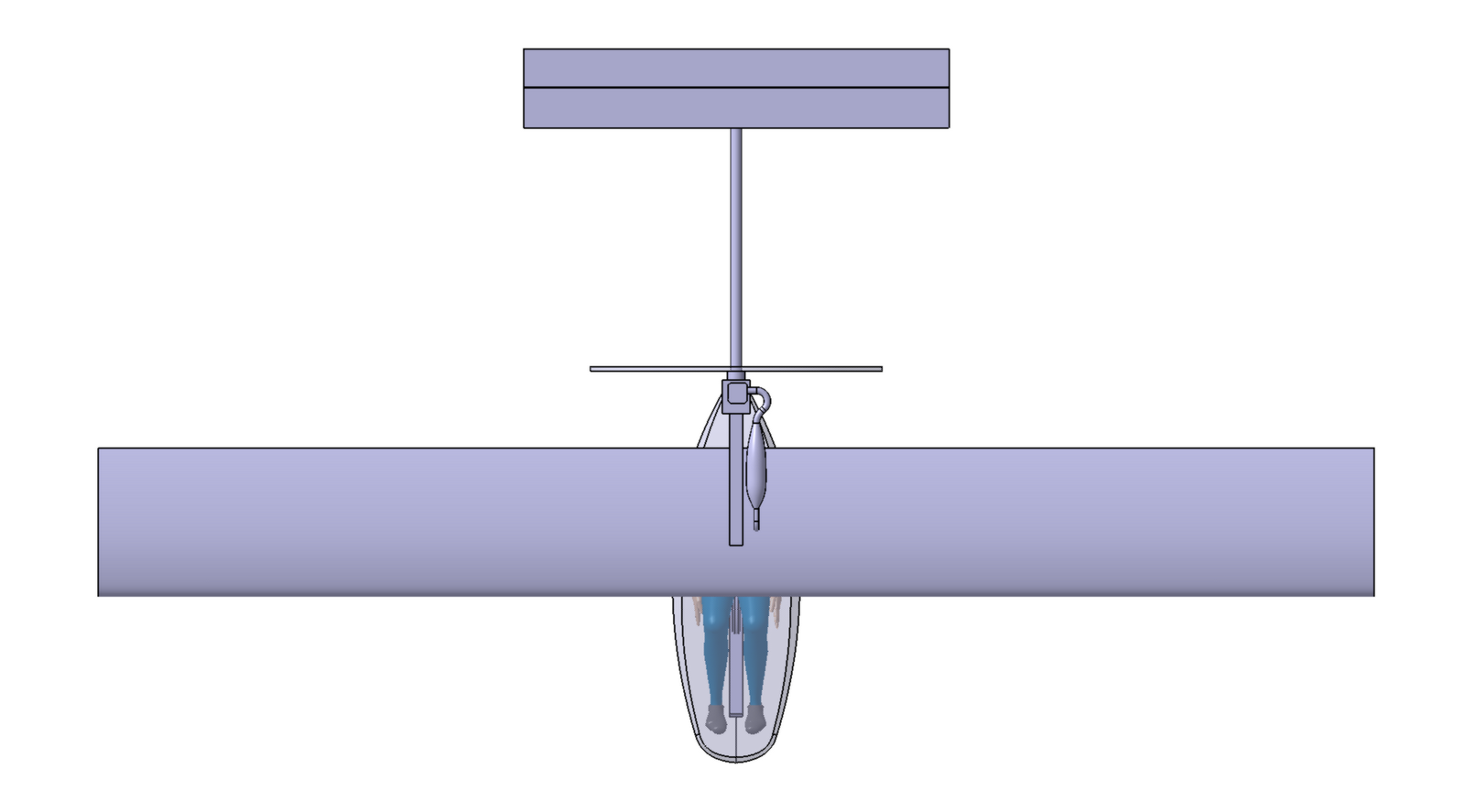
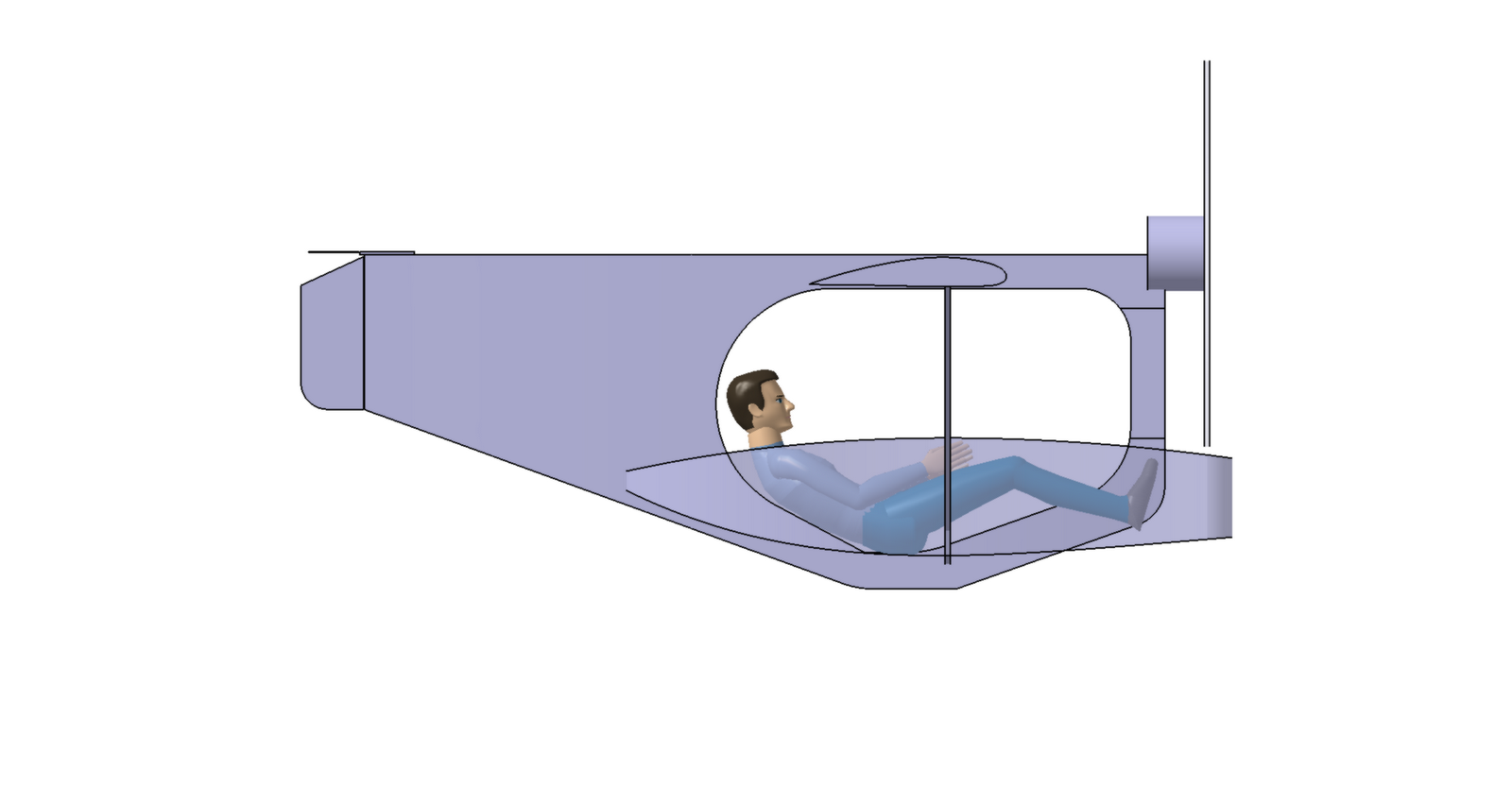
Jean-Pierre showed the previous iterations to a group of pilot friends and they felt that the prop rotating around the boom was a good idea and that we should go back to it. So our latest design combines the high wing with the boom going through the prop hub. Spec is still 31 kilos dry.
Tuesday, November 1, 2011
![]() |
Another version. The fairing construction is not fully decided. The wheel is a standard 305-mm bicycle rim with 375 mm outer diameter. It's very sturdy and if it breaks you can rebuild it with more spokes or thicker spokes. Conventional controls with a side mounted stick (on right hand) and rudder pedals. The transparent color is fabric, 57 g/m2 (1.7 oz per sq yd). The opaque color is 0.8 mm plywood.
![]() |
Sunday, October 9, 2011
triangular frame
Jean-Pierre suggested that the front bar go down directly between the pilot's legs since the fairing will be rigid enough to support the pilot's feet with the rudder pedals. That way the frame is a triangle. I don't always use the computer; here I just drew it up in pencil. The structural members are boxes made of thin spruce (10x10 mm) with some carbon fiber reinforcement and internal foam stiffeners. The weight of the bare triangle, not counting all the attachments - engine mount, wheel mount, fairing mounts, wing mounts etc - should be 2.7 kilos;
Thursday, October 6, 2011
New Design
For this version the weight is still 31 kilos, and the engine is the same 14hp. Cruise speed higher, about 125 km/h. Faired pilot makes radical improvement to efficiency. The skin is 0.8 mm plywood (wing) and 0.4 mm plywood (rear of fuselage, tail, and pilot fairing). Plywood is glued to foam cores and local carbon reinforcement.
Saturday, May 7, 2011
Better Fuselage, Exhaust
I've redesigned the fuselage somewhat to reduce weight, and added the exhaust. The "chair" part of the fuselage will be1mm plywood with foam core.
Saturday, April 30, 2011
31 kilo airplane - new layout
With Jean-Pierre we're working on a new layout where the tail is a carbon tube. The motor we are using, the Raket 120, uses a poly-v belt reduction and with this folding prop that is sold as individual blades, we can make a hub so that the prop effectively rotates around the tail boom. I will be posting a more detailed sketch of the engine mount and how the tail boom goes through it.
SPECS
Radne Raket 120 engine, 14 hp
6 m wingspan, 0.7 m chord, 4.2 m2 wing area, NACA 4415, 3 deg dihedral
3 axis with full span flaperons
Gross takeoff weight 120 kilos
Stall speed 65 km/h
Cruise 110 km/h
VNE 130 km/h
Weight breakdown:
Engine, prop and exhaust 11 kg
Fuselage with controls, tailplanes and undercarriage 10 kg
Wings with struts 10 kg
Subscribe to:
Posts (Atom)